Dr B
The Royal GameDr B is an Austrian lawyer whose quiet work managing monastic and imperial family assets draws the Gestapo’s attention after the Nazi takeover. Imprisoned and isolated, he finds in a stolen chess almanac a way to impose order on empty days; the discipline that first sustains him eventually becomes a perilous compulsion. His encounter with Mirko Czentovic aboard ship brings that history into the present: Dr B proves extraordinarily gifted, but leaves the match rather than risk being consumed again by chess.
Identity and Background
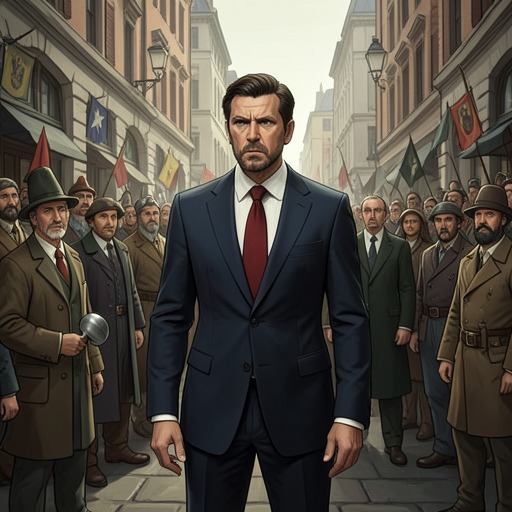
Dr B introduces himself to the ship’s narrator, an Austrian, as a member of a distinguished old Austrian family. The narrator recognizes the family name through its association with Schubert’s circle and with a personal physician to the former Kaiser. Dr B’s appearance is marked by a contrast between a relatively young, pale face and strikingly white hair; the narrator has the impression that he has aged suddenly. A nervous twitch at the corner of Dr B’s mouth recurs as he recounts his past.
He first worked in a legal practice with his father and later ran it alone. The firm avoided publicity and new clients, and its work had narrowed from ordinary legal practice to advising and managing the assets of large monasteries. Through connections inherited over two generations, it also managed funds for members of the imperial family. Dr B describes the work as quiet and dependent above all on discretion and reliability. His father had preserved clients’ substantial estates through inflation and revolution, and Dr B continued that custodial role after his death.
The practice’s inconspicuousness was deliberate: it had no nameplate, and important discussions took place away from the office, at a monastery priory or in an uncle’s consulting room. Dr B says that his firm handled secret political dealings and that imperial couriers used its fourth-floor office to deliver or collect important messages without attracting official suspicion. When the Nazi authorities began targeting Church and monastic property in Germany, the office also handled transactions intended to protect portable assets from confiscation.
Surveillance, Arrest, and Imprisonment
The office’s discretion did not prevent infiltration. A clerk whom Dr B had hired on a priest’s recommendation, partly to make the practice look like an ordinary business, was in fact a National Socialist informer. Dr B restricted the clerk to routine work: answering the telephone, filing harmless documents, and carrying out innocent messages. He kept important correspondence from him, typed significant letters himself without retaining copies, took essential files home, and moved confidential conversations elsewhere. Despite those precautions, the clerk apparently became aware that he was mistrusted and that important business was being conducted beyond his reach.
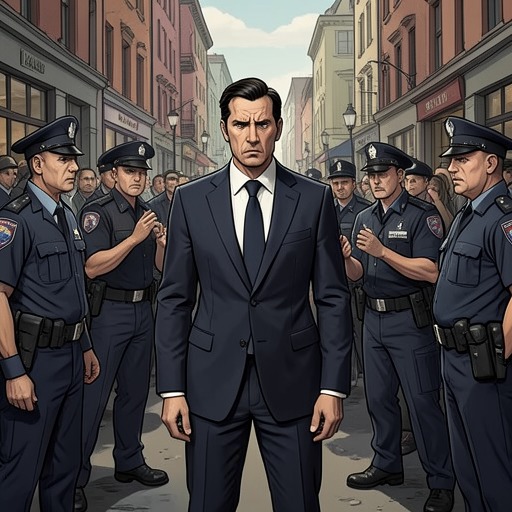
Dr B connects the surveillance to the political crisis surrounding the Nazi takeover of Austria. On the evening Chancellor Schuschnigg announced his resignation, and a day before Hitler marched into Vienna, the SS arrested him. Having heard Schuschnigg’s farewell speech on the radio, Dr B burned the most important papers. At the last moment before his door was broken down, he sent indispensable records concerning assets held abroad for monasteries and two archdukes to his uncle, carried in a laundry basket by his trusted housekeeper. Once imprisoned, he recalled signs that the clerk’s former laxity had given way to sudden diligence, including his eagerness to take correspondence to the post, but says that he understood the significance too late.
Dr B was not sent to a concentration camp. The Gestapo placed him among a small group of detainees from whom it hoped to extract money or information. Investigators wanted evidence that monasteries had transferred assets fraudulently, as well as information about the imperial family and those who had supported the monarchy. They also suspected that some of the money handled by the firm remained beyond their reach. Dr B was therefore held at the Hotel Metropole, the Gestapo headquarters, in what appeared to be more favorable conditions than a prison camp but served a different purpose: prolonged isolation intended to make him disclose what he knew.
His room contained a bed, armchair, washbasin, table, and barred window, but the door remained locked and the window faced a firewall. Books, newspapers, paper, writing instruments, and personal possessions were taken away; even his watch and cigarettes were denied him. The warder did not answer questions or speak. For fourteen days, Dr B saw no other human face and heard no human voice. With only a handful of silent objects to occupy his attention, he repeatedly stared at the same zigzag pattern on the wallpaper until its lines became fixed in his memory. The room’s stillness and sameness left him alone with thoughts that had no new information or activity to interrupt them.
Interrogation and the Chess Almanac
After fourteen days, the Gestapo began taking Dr B to interrogations. He was brought through corridors without knowing whether it was day or night and questioned by uniformed officials whose files he could not see. The uncertainty about what his interrogators already knew made every answer consequential. If he disclosed something new, another person might be endangered; if he denied too much, he might expose himself. The questions concerned monastery investments, banks, correspondence, and people who might connect the firm to its clients. Back in his room, Dr B repeatedly reviewed his answers and imagined what the officials had recorded. The questioning continued in his thoughts long after each formal session had ended.
As his capacity to endure the isolation weakened, Dr B tried to occupy himself by reciting and reconstructing material he had learned by heart. During one interrogation, he noticed a book on a table and managed to take it. He concealed it under his clothes, once having to disguise a dangerous slip in the corridor by pretending to cough. The book proved to be a chess almanac containing 150 games between grandmasters, not the literature or poetry he had hoped to find. At first, its notation seemed unintelligible, and the absence of a board and pieces made its use uncertain.
Dr B worked out that the letters represented the board’s columns and the numbers its rows. He used the check pattern on his bedcover to make a board of sixty-four squares and crumbs saved from his bread to shape crude pieces, darkening some with dust to distinguish them. Reconstructing and playing through a game was initially difficult: he repeatedly lost track and had to start over. After six days, he could play one game through correctly. Eight days later, he no longer needed the crumb pieces to visualize its positions, and after another eight he no longer needed the bedcover’s squares. The almanac’s abstract notation had become a set of vivid internal positions, allowing him to play its games blind.
The book gave structure to time that had previously seemed formless. Dr B divided each day into two games in the morning, two in the afternoon, and a quick review in the evening. Repetition grew into genuine appreciation: he began to recognize the techniques, attacks, defenses, and distinctive styles of the grandmasters whose games filled the volume. He describes the players as companions in his solitude. The concentrated practice sharpened his thinking, and he found that he could meet the Gestapo’s questions with greater clarity and resist their attempts to unsettle him. The almanac had begun as a stolen object and a practical defense against isolation; it became a mental world in which he could recover discipline and pleasure.
Playing Against Himself
Once Dr B had mastered all 150 games, the activity that had sustained him no longer offered the same challenge. He saw that the next step would be to invent games and try to play them against himself. In his account, this was not simply difficult but logically contradictory. Chess depends on two minds concealing and anticipating their intentions; a player facing himself would have to remember and forget a strategy at will. A real board might have given him some physical separation between the two sides, but Dr B had none. He attempted instead to divide his thinking into a black self and a white self, compelled by the fear that without this effort he would sink into insanity or mental atrophy.
The attempt marks a change in the role chess plays in his life. The almanac’s fixed games had made isolation bearable by supplying a finite structure and repeatable routine. Playing against himself demanded that he produce the opposition as well as answer it, dividing a single mind between incompatible positions. Dr B says that the resulting occupation placed such strain on him that he could not control himself while it was under way. His later caution about chess rests on this history: what had functioned as a defense against the empty room had also opened a path toward a dangerous mental state.
A doctor eventually helped secure Dr B’s release, though Dr B does not know what the doctor told his captors. He speculates that the doctor may have declared him mentally unsound, or that the Gestapo’s interest in him had diminished after Hitler occupied the Sudetenland. Dr B had to sign a promise to leave his homeland within fourteen days. The many official formalities required for departure occupied that short period, and he says he could not then think much about what had happened. For weeks, attempts to recall the cell seemed to fail; only aboard ship did he find the courage to return to the memory and tell it.
The Shipboard Match and Its End
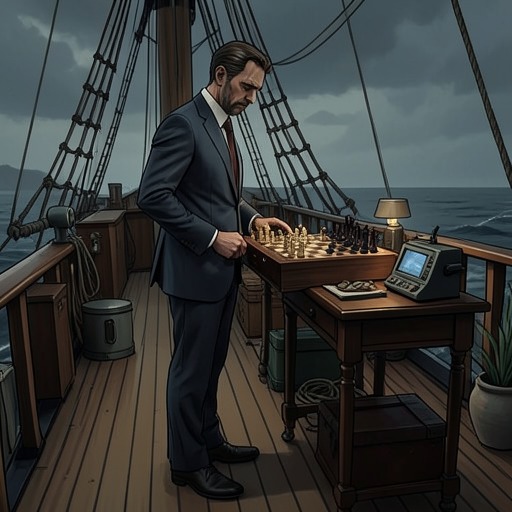
Dr B first sees chess again in the ship’s smoking room, where Mirko Czentovic is playing McConnor and the other passengers. The real board and pieces surprise him: he had forgotten that chess could be played physically by two people facing one another. When he recognizes the game in the movements of the pieces, he becomes absorbed in the position. He intervenes impulsively to stop what he sees as a mistaken move, only afterward recognizing that he has intruded on the players’ game.
The passengers ask him to play Czentovic, the world champion. Dr B agrees after a long hesitation, but emphasizes that he has not touched a chess piece since his schooldays, more than twenty years earlier, when he was only an average player. He had not realized that the opponent whose play he had answered was a recognized grandmaster. Once told, he repeatedly asks whether this is certain; even so, he warns the group not to expect too much from him. His interest is not a claim to professional strength but a test of whether the games he played alone in confinement had been chess at all, or a fevered activity close to madness.
The following day, at three o’clock, Dr B sits down to play the world champion in the smoking room, watched by the narrator, McConnor, and two ship’s officers. The match’s moves are not preserved: the spectators later try and fail to reconstruct them, having watched the players more closely than the board. Their contrasting manners remain vivid. Czentovic is rigid and intent on the position; Dr B is relaxed, talks during the intervals, lights a cigarette steadily, and looks at the board only briefly before replying. As the game develops, Czentovic takes longer to think, while the spectators lose their ability to judge the position or understand the players’ plans.
Dr B has agreed to one match only. He calls it a test and a closing of an old account, not the beginning of a return to chess. He tells the narrator to warn the others that he must stop after this trial, recalling that a doctor had explicitly warned him that anyone who had once fallen into a mania remained at risk. Chess, he believes, had poisoned him before, even though he considers himself cured. This boundary shapes the meaning of the encounter: the match can test his ability, but continuing to play would threaten the very restraint that makes the test possible.
Near the end, Dr B suddenly asks whether he has done or said something insane. The narrator tells him to stop immediately and reminds him of the doctor’s warning. Dr B rises, apologizes courteously to Czentovic, disowns his earlier intervention in the game, and says that it is Czentovic’s match. He also apologizes to the assembled spectators, calls the episode a failure, and declares that it is the last time he will play chess. He leaves with the same humble reserve with which he first appeared. The narrator alone understands why Dr B will not return to a chessboard; McConnor is disappointed, while Czentovic acknowledges that Dr B’s attack had been well set up and that he is extraordinarily gifted for a dilettante.
Character and Narrative Significance
Dr B’s story turns on the double meaning of mental discipline. In the cell, chess gives him a world of structure and variation where the Gestapo has deliberately reduced his surroundings to a locked room and a few objects. Learning the almanac’s games restores concentration and helps him withstand interrogation, yet trying to create an opponent within himself turns the same activity into a threat. His ability is inseparable from the circumstances that produced it, and the brilliance visible to the passengers cannot be separated from the risk he recognizes in himself.
The frame narrative also makes his account a delayed act of recollection. For a time after his release, he cannot bring himself to remember the cell; on the ship, seeing the board first reawakens the experience through physical chess pieces, and only later does he tell the narrator what the game recalls. The spectators witness the consequences of his past without knowing its cause, while the narrator’s private knowledge explains the abrupt ending. Dr B’s final withdrawal is therefore not an unexplained surrender to Czentovic: it is a deliberate limit, imposed to prevent a single test from becoming the renewed obsession he has spent years fearing.